

In March 2026, I flew ANA’s 767 domestic economy class from Fukuoka to Tokyo. I did this for a couple of reasons – I wanted to see what flying domestically within Japan was like, and I wanted to fly my first 767. As a result, when I found myself with an extended layover in Tokyo during the return portion of my trip to Australia, I booked a direct turn to Fukuoka, and was sure to pick up a flight featuring ANA’s 767.
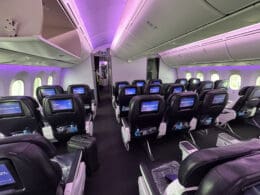
The 767 isn’t ANA’s most modern aircraft on the route, or even in the country. The airline operates some high-density 777s and 787s, both of which feature seatback entertainment screens, 110V power ports and more modern seat features. However, most passengers will likely be keeping themselves busy with the free and fast inflight WiFi available onboard these jets, and the 767s even have the advantage of having a more comfortable seating configuration in economy (with a 2-3-2 configuration as opposed to a 3-3-3 configuration).
I’m still keen to compare Japan Airlines and ANA’s latest-and-greatest domestic products, though would recommend flying the 767 domestically – especially if you’re travelling with one companion and booking further in advance, where you’d be able to sit together in one of the plane’s “duo” seats. Here’s my experience.
Booking ANA’s Domestic 767 Economy Class
I booked my flight in ANA’s economy class for 7,500 Virgin Atlantic Flying Club points, plus a £2.60 “Passenger Facility Charge”. ANA award seats don’t show on Virgin Atlantic’s website, so I had to make this redemption over the phone. This was a pleasant experience, and if you have to cancel your ticket, you just have to forfeit the £2.60 (which meant it was more or less changeable and refundable, less a very small surcharge). It’s not possible to book domestic first class using Virgin Points, though you can upgrade at the airport subject to availability.
From looking at the calendar, booking this one-way flight costs around JPY 11,890 (~£55) far out, and JPY 14,530 (~£68) if you’re booking a bit closer to departure.
ANA Economy Class Ground Experience at Fukuoka Airport
When flying an ANA domestic flight within Japan, you could genuinely arrive at the airport up to half an hour before departure. In this case, I arrived on my StarFlyer flight around 3h before my ANA flight, and actually had time to pop out to the Hakata region for some tonkotsu ramen and a wander. (While this is the wrong forum to elaborate it further, I wouldn’t go out of my way to Fukuoka just to try their ramen – while the ramen scene is certainly more rooted in local tradition, you can get an equally flavourful bowl in Tokyo.)
Online check-in is quick and straightforward, though if you’d like, you can check in a bag up to 23 kg free of charge, even if you redeem miles.
In this case, I did drop by the counter – I didn’t have a bag to check, though I wanted to ask them about upgrading to Premium class (so I could review it). If available, you can upgrade to Premium Class on a domestic flight within Japan with cash, for a set price at the airport counter – these can be quite a bit cheaper than retail price, e.g. it would’ve cost 15,000 JPY (£69) for me to do it on my 1h 40m flight.
Perhaps avoid the 767 if you’re looking to upgrade, as their Premium class only features 10 seats, so availability is low. This was the case on my flight – I was invited to join the standby list, though I declined. If successful, you’ll get a recliner seat and an onboard meal – I hope to review this in the future.
Most of Japan’s airports have an observation deck landside. I didn’t realise how awesome Fukuoka’s would be, and it reminded me of Haneda Airport’s – I spent some time gazing at the aircraft below, including the numerous domestic ANA widebodies operating from this part of the terminal.


Fukuoka Airport Landside Observation Deck
Boarding was scheduled for 5:15 PM, a mere 15 minutes ahead of our departure time. So I headed airside slightly before that. Fukuoka’s domestic terminal sells wild things, from fresh uni (sea urchin) to mentaiko, to other delicious goods. If you’re not interested, the airport also has some workstations set up, which seems to be an intentional design feature in most of Japan’s largest domestic terminals.

Fukuoka Airport Domestic Terminal Workstations
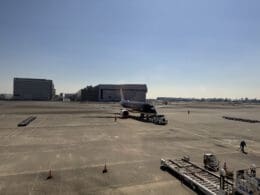
As boarding time neared, I was sure to catch a glimpse of the first 767 I’d ever fly. This was JA618A, a 17-year-old 767 that had flown for ANA/Air Japan (subsidiary) all of its life. Today it would be carrying me on the short hop from Fukuoka to Tokyo Haneda.

ANA 767 at Fukuoka Airport
The gate area got ready for boarding, and it even started a little earlier than planned, with Premium Class and Star Alliance elites being called to board first at around 5:10 PM.

ANA Gate Area at Fukuoka Airport
Much like StarFlyer (and Japan Airlines, for that matter), ANA boards window seat passengers first in Group 3, followed by middle seat passengers in Group 4, followed by aisle seat passengers in Group 5. As someone who generally prefers the window seat, I certainly didn’t mind the opportunity to board first, where I could have a look at this beautiful 767.

ANA 767 at Fukuoka Airport
ANA Flight NH1078
Thursday, March 12, 2026
Origin: Fukuoka (FUK) T: D Gate: 7 Dep: 17:30 (17:35)
Destination: Tokyo Haneda (HND) T: 2 Gate: 57 Arr: 19:10 (19:10)
Duration: 1 hr 40 min (1 hr 35 min)
Aircraft: Boeing 767-300 Reg: JA618A
Seat: 40A (Economy Class)
ANA 767 Domestic Economy Class Cabin and Seat
ANA’s 767s are some of the highest-density 767s you’ll find out there, with 270 seats (in comparison, United’s premium-heavy 767s only have 167 seats). After passing the intimate Premium cabin with 10 seats, I found myself in the large, cavernous 260-seat economy cabin, spread across 37 rows.
Notably, there isn’t a proper bulkhead between the two economy cabins – there’s a centre bulkhead that houses the lavatory, though otherwise the window pairs go all the way “through” to the back of the cabin, except for a brief gap where the exit row is before row 21.


ANA 767 Domestic Economy Class Cabin
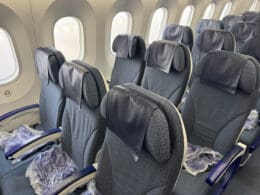
ANA introduced slimline Toyota Boshoku seats onboard their 767s in 2015 – this particular aircraft was refurbished in 2020. The cabin was a very recognisable signature “ANA blue”, and there’s around 31″ seat pitch.
Compared to the competition, Japan Airlines has a similar seat on their 767s, whereas ANA’s 777s and 787s feature entertainment screens and AC power ports (though still no adjustable headrests). Meanwhile, Japan Airlines’ 787s and A350s feature Recaro CL3710 seats that you’d expect to find a longhaul aircraft, with AC power ports, adjustable headrests at every seat, enhanced storage pockets, and an inflight entertainment screen.


ANA 767 Domestic Economy Class Cabin “Duo” Seats
So, how’s the 767, as a first-timer on this aircraft? Well, I’m a fan, at least if I’m in economy. The 2-3-2 configuration means that there’s the lowest proportion of middle seats out of any widebody aircraft, I like the duo pairs by the side, and I like that the windows are larger than the otherwise similarly-sized A330. I understand that business class on this aircraft tends to be quite tight, though these would be among my favourite aircraft to fly in economy.
I managed to snag one of the last remaining window seats in this configuration, seat 40A. This seat was featured in the third row from the back, and even came with an audio jack, where you could tune into one of a few audio channels (I didn’t have headphones, so didn’t use this feature). The seat barely features any recline – below is a picture of the seat in the reclined position.

ANA 767 Domestic Economy Class Seat 40A Recline
Since these were slimline seats, legroom felt substantial, especially considering the plane doesn’t operate flights much longer than the one I was on. There was also a seat pocket that was large enough for a laptop.

ANA 767 Domestic Economy Class Legroom
The 767s feature USB-A power ports, though if you’ve got a USB-C charger or a laptop to charge, you’re out of luck. ANA’s newer 777s and 787s will have AC power ports, though.

ANA 767 Domestic Economy Class Charging Ports
There was also a tray table that folded out of the seat in front. The cupholder was a perfect size for the cups that the airline provides, unsurprisingly as this seat was custom-made for ANA.

ANA 767 Domestic Economy Class Tray Table
There are pros and cons to taking the 767 on this route. On the plus side, I really like the 2-3-2 configuration, and don’t mind the lack of a screen at all. At the same time, both my laptop and my phone were running out of charge, and in my lack of planning I hadn’t packed a USB-A adapter. So prioritise one of ANA (or Japan Airlines’) newer aircraft if an AC charging port is a priority.
Taking off from Fukuoka Airport
Boarding was super efficient – while the plane had a few empty seats in the back, the seat next to mine wasn’t one of them. Domestic air travel in Japan runs like a well-oiled machine, and our flight departed just three minutes behind schedule.

ANA 767 View at Fukuoka Airport
At this point, ANA’s safety video was screened on the overhead monitors.

ANA 767 Domestic Economy Class Safety Video
It was such a beautiful day in Fukuoka, and I enjoyed the views of various domestic aircraft, ranging from Jetstar Japan A320s to Japan Airlines widebody aircraft.


Taxiing at Fukuoka Airport
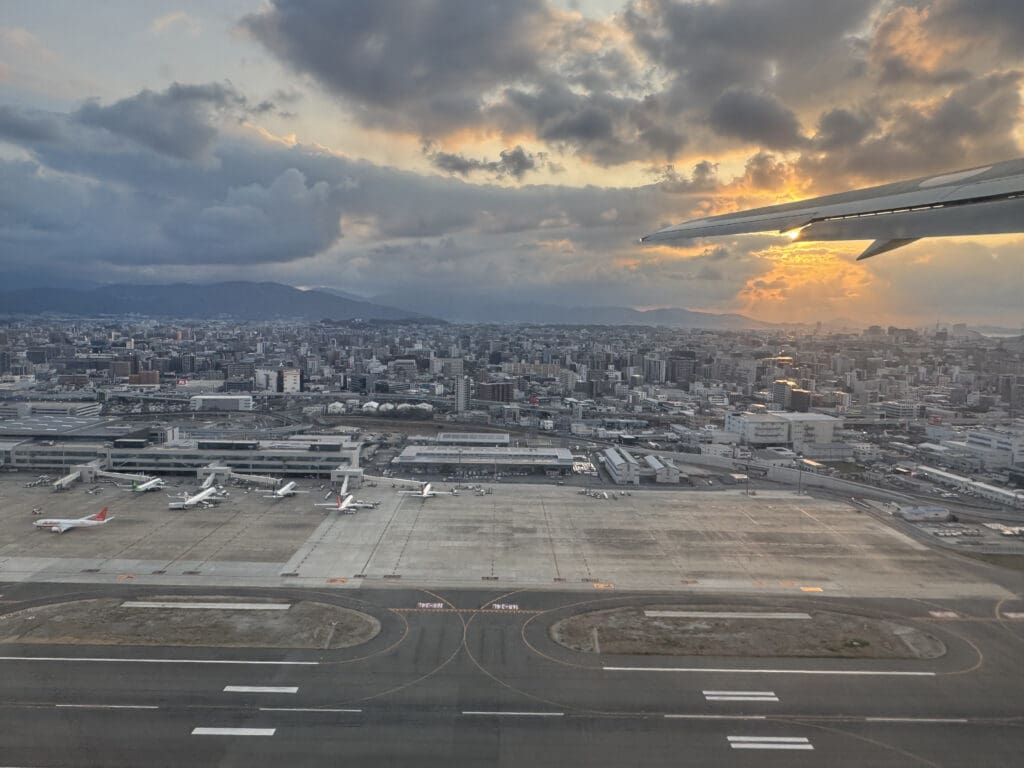
It was also a beautiful takeoff from city-centre Fukuoka Airport, especially as we took off just as the sun was about to set. As a side note, the route between Haneda and Fukuoka seems designed for a business commute, as both airports are close to the city centre and very easy to navigate. I also loved seeing Fukuoka from above, and can’t wait to be back.

Taking off from Fukuoka Airport
There was a bit more cloud cover than we’d had in Haneda, so soon we reached our cruising altitude, heading northeast towards Tokyo.

Cruising after Takeoff from Fukuoka Airport
ANA 767 Domestic Economy Class WiFi
Japan Airlines and ANA have offered fast, free gate-to-gate WiFi onboard their widebody domestic fleet since 2018 (with Japan Airlines leading the way and ANA following suit shortly after). The speeds aren’t quite Starlink-level, though they are faster than what you’d get onboard most planes. My speed test measured 37.7 Mbps down and 5.43 Mbps up.
If I frequented the route as a business traveller, I’d definitely see merit to choosing a full-service carrier over a low-cost carrier for the WiFi alone (especially if I wasn’t paying – Japan Airlines and ANA charge ~£10 more on this route one-way compared to the low-cost carriers). I’d consider this to be one of the more important amenities, and in fact would forego an inflight entertainment system on this domestic route if it meant I could get some work done.
StarFlyer is an airline to watch, though, as they offer inflight WiFi onboard their A320neo fleet, while matching the low-cost carriers on price in many cases. However, they don’t have the route frequency to compete with the major carriers, and their older A320s also don’t have WiFi.
ANA 767 Domestic Economy Class Streaming Entertainment
ANA features streaming entertainment on all of their 767s (some of their 787s also only feature streaming entertainment, and not seatback entertainment screens). Most of their flight times will be barely enough to finish a movie, though the selection is quite good, comparable to what you’ll get on the airline’s longhaul aircraft.
I can’t report back on how well the streaming system worked, however, as I didn’t have enough battery on my phone in order to properly test this feature out.

ANA Streaming Entertainment
Maybe I’m personally much less fussed about an inflight entertainment screen compared to others, though I wouldn’t go out of my way to choose a 777 or 787 in order to get a seatback entertainment screen. Assuming my devices are on full charge (or I have a USB-C to USB-A adapter), WiFi and streaming entertainment is good enough for me.

There is shared big screen entertainment (with an audio channel to your seat), if you’re into that
ANA 767 Domestic Economy Class Drinks Service
Much like my experience on StarFlyer, ANA provided a drinks service onboard this 1h 40m flight. This was served around 20 minutes after takeoff.
Choices include:
- Coffee (hot/iced)
- Japanese green tea (hot/cold)
- Apple juice
- Cola
- Water
- ANA’s Original beef consommé soup
As you can see, there’s the classic Japanese soup-in-a-cup option – there was also iced coffee, which I wasn’t expecting. Otherwise, the drinks selection is quite standard. I was feeling quite thirsty and a beef consommé wouldn’t quite assuage it (which otherwise would’ve been the most attractive thing on the menu), so I went for an iced green tea.
Apologies, this isn’t the best photo in retrospect – the cup is bigger than it looks in the below picture, as I’d placed it in the cupholder (which goes underneath the tray table).

ANA 767 Domestic Economy Class Drinks Service
Along with the drinks service, ANA serves little Fukushima cookies, which had packaging that commemorated 15 years since the 2011 Tōhoku earthquake. This is a nice little premium touch, and more than what you’d typically get on a domestic Japanese route.

ANA 767 Domestic Economy Class Fukushima Cookie
While sipping on my (iced) green tea and having my cookie, I also admired the setting sun outside, as well as the gorgeous 767 wing.

Sunset during Cruising towards Haneda Airport
Overall, you’ll get an extremely standardised drinks service in economy onboard any Japanese airline, with a choice of beverages or consommé in a paper cup. Granted, it’s so easy to get good food and beverages in Japan that I wouldn’t splurge for a higher cabin just to get a decent meal service.
ANA 767 Domestic Economy Class Lavatory
At some point during the flight, I visited one of the three lavatories available to economy passengers onboard this 767 – two are located in the middle of the aircraft, and one is located at the back to the right. Curiously, there aren’t any bathrooms on the left, except for the one reserved for Premium class at the front.
The lavatory was extremely standard, and similar to what I’m used on older 777s.

ANA 767 Domestic Economy Class Lavatory
The only noticeable difference was the hands-free feature (with an elbow lever to open the door), a COVID-19 addition that I’d also spotted on my preceding international 787 flight.

ANA 767 Domestic Economy Class Lavatory Hands-Free Functions
Landing into Haneda Airport
The rest of the flight was uneventful, and at around 6:55 PM (less than 10 minutes before landing) the seatbelt sign was turned on, preparing us for landing into Haneda Airport.

Landing into Haneda Airport
We landed just before 7:05 PM, and taxied to Terminal 2, where we parked next to a series of domestic 787s.

Taxiing to Haneda Airport Terminal 2
I caught a glimpse of my first ever 767, before making my way out to an evening commitment in town in Tokyo.

ANA 767 at Haneda Airport
Conclusion: ANA 767 Domestic Economy Class
There’s no denying that ANA’s 767s have an older product, especially compared to Japan Airlines’ domestic A350s and ANA 787s operating the route. However, I don’t think it matters that much, even on these high-frequency routes – the WiFi is sufficient to keep me entertained. ANA and Japan Airlines command a minor price premium over low-cost airlines, though the WiFi and frequent flyer status accrual would be enough for me to justify it. The only exception is StarFlyer (which has WiFi and you can credit to ANA Mileage Club), though they don’t have quite the schedule to compete with the major players.
Regarding whether I’d avoid the 767 for a more modern aircraft – in some ways I might even prefer sitting in a duo window pair over the 3-3-3 configuration on 787s/3-4-3 configuration on 777s, and some of those planes don’t even have seatback entertainment screens. The 787s and 777s also have AC charging ports, so overall I’d say the customer experience is neck-and-neck (though I’m much less fussed about an AC charging port when the maximum flying time of these planes is 2.5 hours).
All of the full-service domestic Japanese carriers are on a level playing field when it comes to food and beverage in economy. The selection is decent, though I’d save my appetite for the ground (or fly Premium, though I wouldn’t upgrade for the food alone, even if I was given a promotional rate at the airport).
Outside of this, I also enjoyed my first ride on the 767. I’m not sure I’d seek it out in the future unless I were guaranteed one of the duo seats in economy, though I look forward to my next 767 flight!
Have you flown ANA domestically within Japan before? How was your experience?