



The aviation industry is an operational extravaganza, and features more moving parts than most people are aware of, from safety to logistics constraints. If you’re a frequent traveller, most likely you’ll run into at least a couple of departure delays a year, where a flight will be rescheduled on the day to a time later than its scheduled departure time either due to a flight, weather, or other operational constraint. These are frustrating, but are familiar, and travellers usually plan contingency in case of a departure delay (due to how common they are).
Today I wanted to talk about something that I’m very guilty of not planning for – taxi-in delays. A taxi-in delay is when a plane is delayed between when it lands and when it arrives at its assigned stand, whether it be a gate or a remote stand. These can be especially frustrating, since you can usually see the terminal from the plane, though you won’t actually be able to leave the plane until it arrives the stand.
What is a taxi-in delay? What causes it?
A taxi-in delay is a greater-than-expected taxi-in time, which is the time it takes between when a plane touches down and when it arrives at its stand. Taxi-in delays can be caused by a lack of gate availability, congestion and traffic, or other airport operational requirements.
Although not technically a “delay”, I’ll still count instances where a plane lands early, though has to wait until their scheduled arrival time or later for a gate to open up. These are very common at airports that are heavily slot-constrained, since there’s a specific allotted time for a stand to be used for an aircraft.
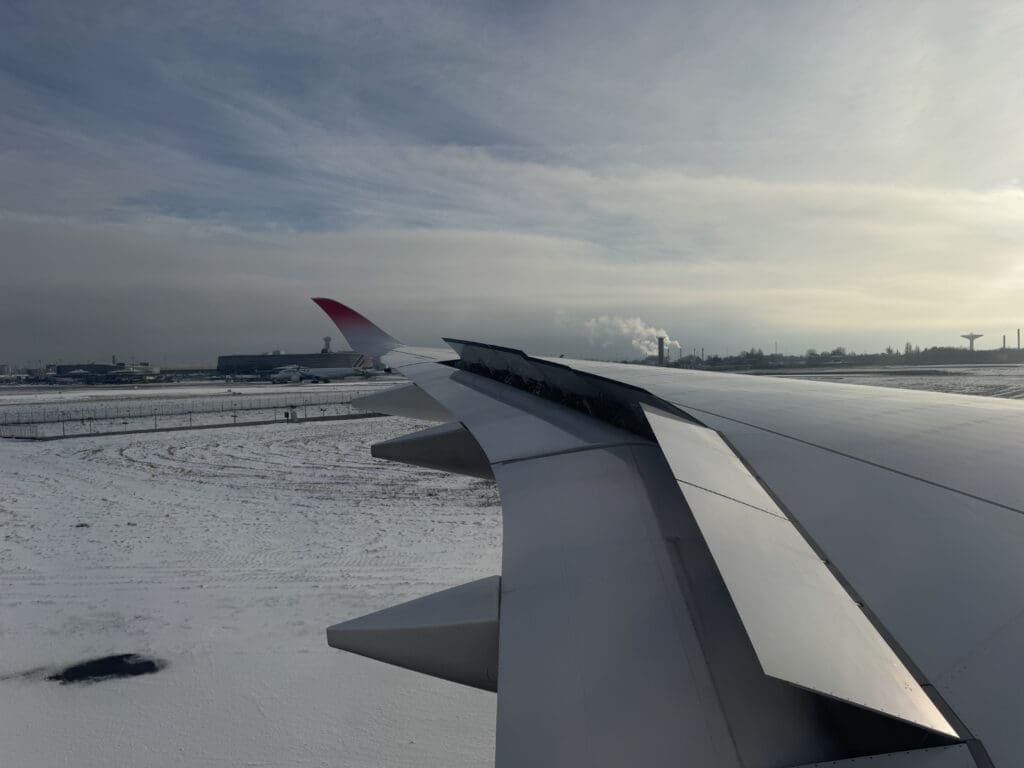
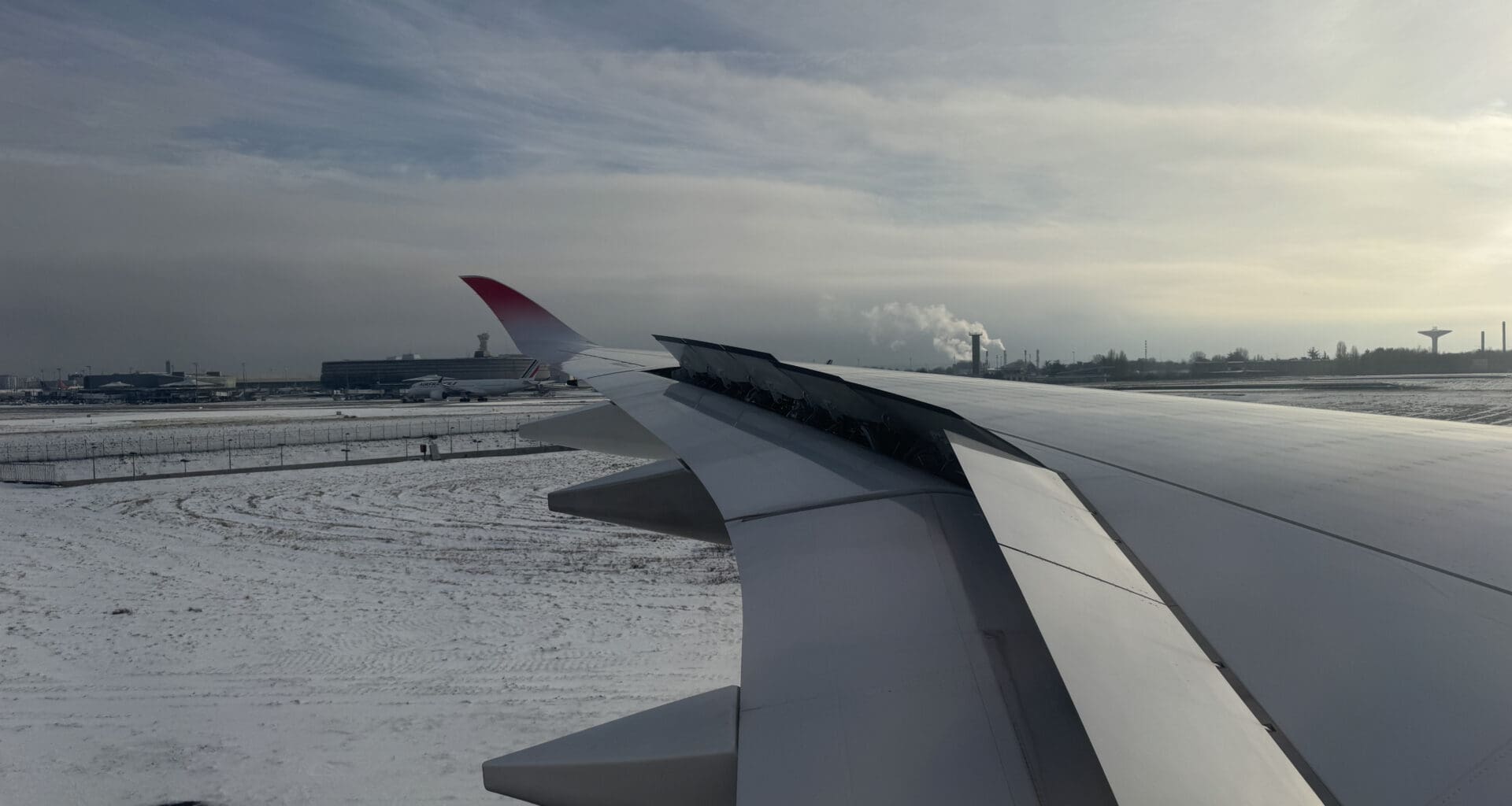
Paris CDG was snowed in yesterday, so we had a two-hour taxi-in delay on my Japan Airlines flight (the pilots were good at communicating the situation to us, but CDG provided them an estimated arrival time that we then missed)
From a passenger perspective, a taxi-in delay means that you just sit on the plane between when the plane lands, and when it arrives at the stand. Sometimes you’ll be told on the plane how long to expect this delay to be (and the seatbelt sign may turn off, meaning you can use your seat as you’d be able to in the air), and sometimes the airport won’t provide much information, and you’ll just be asked to keep your seat in the upright position.
I actually think these are some of the most frustrating delays:
- If a departure delay affects your overall itinerary, you can usually rebook in order to reach your destination or catch your connecting flight; in the case of a taxi-in delay, you’re stuck on the plane with no option to leave, and sometimes can even see your connecting flight leave the terminal
- Taxi-in delays sometimes require you to keep your seat upright and your seatbelt sign fastened, which can be uncomfortable (especially if you’ve already been on the plane for a long time, and/or you need to use the bathroom)
- People don’t usually plan for taxi-in delays, so this can usually cause an unprecedented change of plans (for example, if you have family waiting at the terminal, and/or you have a train booked from the airport)
- You usually have no access to any information about your estimated gate arrival time (ATC is notoriously not great at communicating a reassuring level of information to pilots)
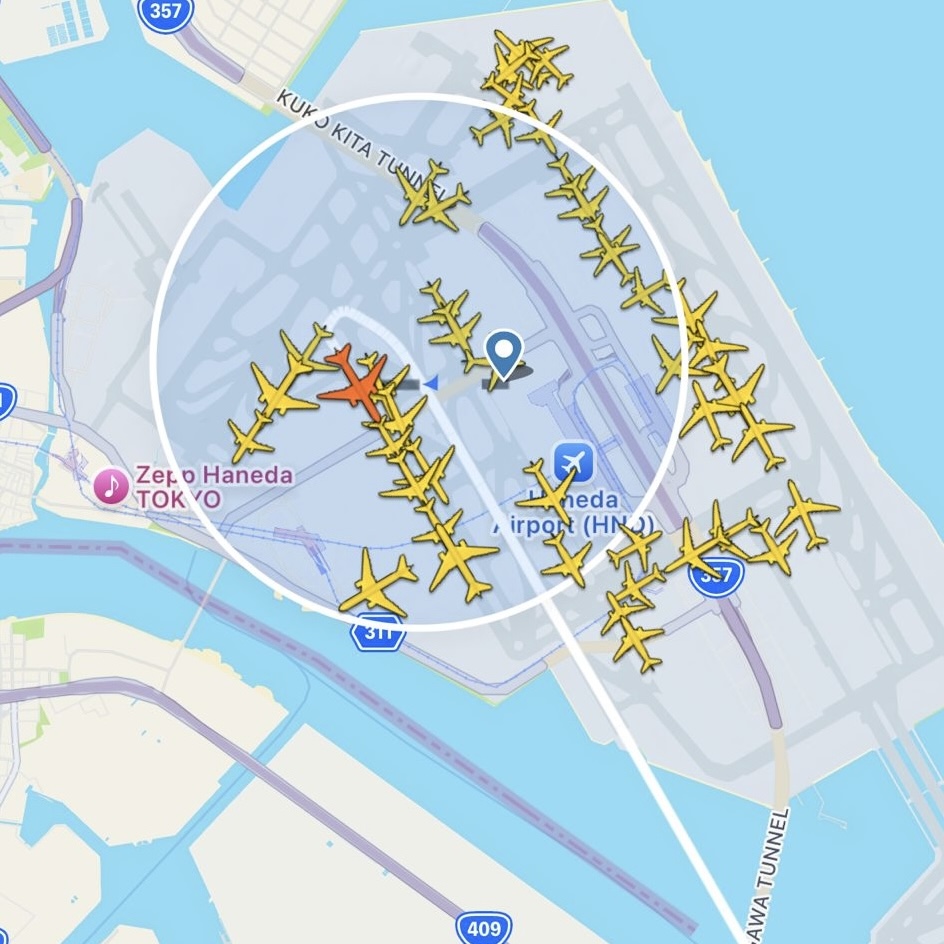
A severe thunderstorm warning caused a 2-hour taxi delay for me at Haneda Airport last year, as it was unsafe for ground staff to work outdoors – here are 30+ planes that were in the same situation
Generally, airlines also hate taxi-in delays:
- Taxi-in delays don’t tend to be an airline’s fault, especially at outstations
- Much like any other delay, this causes rolling delays for the following flights meant to be operated by the aircraft
- The crew are “on duty” (since the door hasn’t opened yet), meaning that there’s a risk of the crew timing out: if that happens, entire crew rotations could be cancelled, causing more delays and cancellations for the airline
- Engines are kept on, causing unnecessary fuel costs (unlike if a plane is delayed at the gate)
My firsthand examples of taxi-in delays
I’ve had the privilege of going through one taxi-in delay per year in the past three years:
- In 2024, my Norse Atlantic flight landed at New York JFK ahead of schedule, though there wasn’t a gate available for us, so we had an hour-long taxi-in delay
- In 2025, my Cathay Pacific flight landed just before a huge thunderstorm at Haneda, and the government issued a warning telling people not to go outdoors – this meant that ground staff couldn’t work, and we couldn’t be guided to an arrival stand, causing a 2h taxi-in delay until the weather subsided
- In 2026, my Japan Airlines flight landed in the aftermath of an orange snow alert at Paris-CDG, and the flight originally at our arrival gate was delayed with no other gates available, causing a 2h taxi-in delay
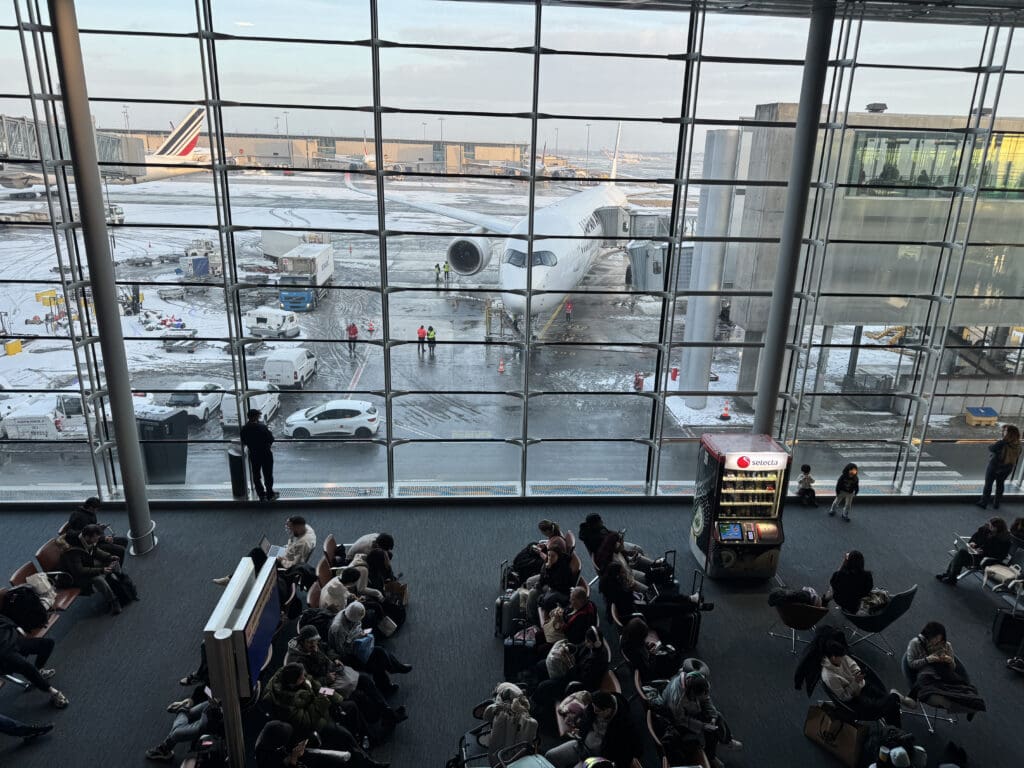
Our Japan Airlines A350 rocking up at our CDG gate two hours after landing
How long do taxi-in delays tend to be?
On the plus side, it’s very rare for a taxi-in delay to exceed an hour. Airplanes are treated as “red cells” when they carry passengers, and especially since there are fewer safety considerations for an arriving aircraft compared to a departing aircraft (e.g. there’s less need to worry about refuelling, etc.), it’s easier to prioritise getting people off the plane. This means that a “major” taxi-in delay would be along the realm of 1-2 hours, as opposed to a major departure delay, which can exceed 5+ hours.
However, adverse weather events and other uncontrollable circumstances mean that taxi-in delays aren’t predictable. For example, last month a Delta flight took three hours to taxi from the airport to the terminal at New York JFK, due to worsening weather conditions.
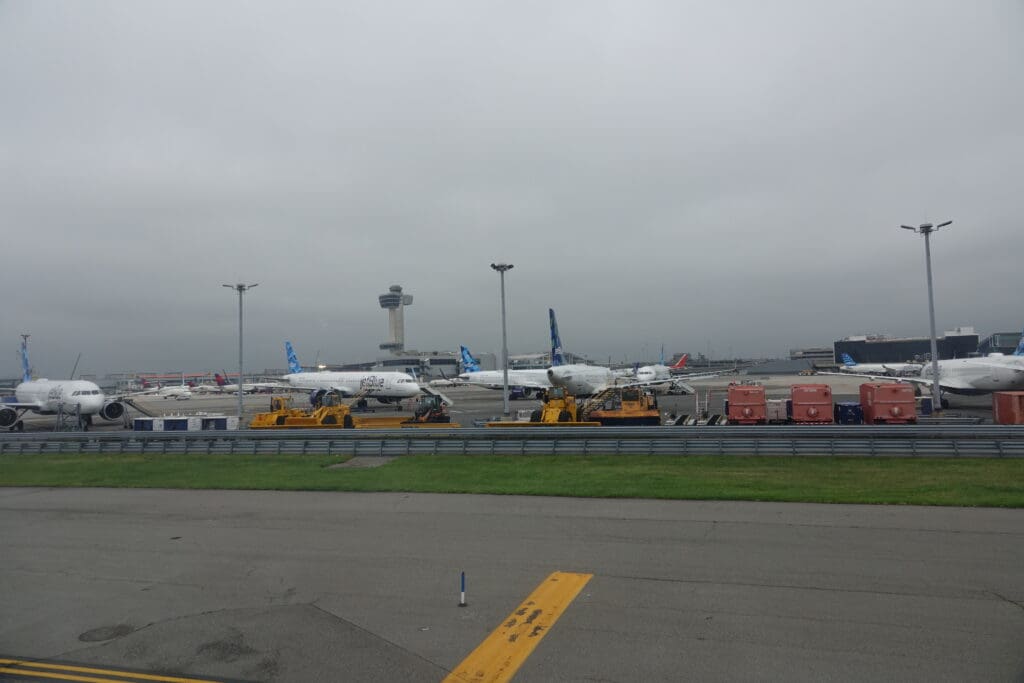
A United flight took three hours to taxi from the runway to the gate at JFK
Are taxi-in delays eligible for compensation?
Yes – the total delay time of a flight is measured by when the door opens. Since the door isn’t open during a taxi-in delay, you’d be eligible for compensation if either your itinerary or insurance allows for it.
However, the most common cause of a taxi-in delay tends to be due to extreme weather incidents, or incidents outside of an airline’s control. These incidents aren’t usually covered by compensation – for example, EC261 compensation (where flights on EU airlines or flights to the EU are compensated if delayed for three hours or more) doesn’t cover delays caused by weather or air traffic control, so you wouldn’t receive delay compensation here.
Will airlines rebook you if you have a taxi-in delay?
Taxi-in delays are treated like any other delay (except for the fact that airlines generally will have less time to react, since they don’t happen a long time away from your connecting flight). If your connecting flight is on the same itinerary, the airline you’re flying has a duty of care to get you to your final destination, regardless of how you booked your ticket.
However, if you’re connecting between two separate itineraries, the airline has no obligation to get you to your final destination, since the risk of misconnecting falls on you in that case.
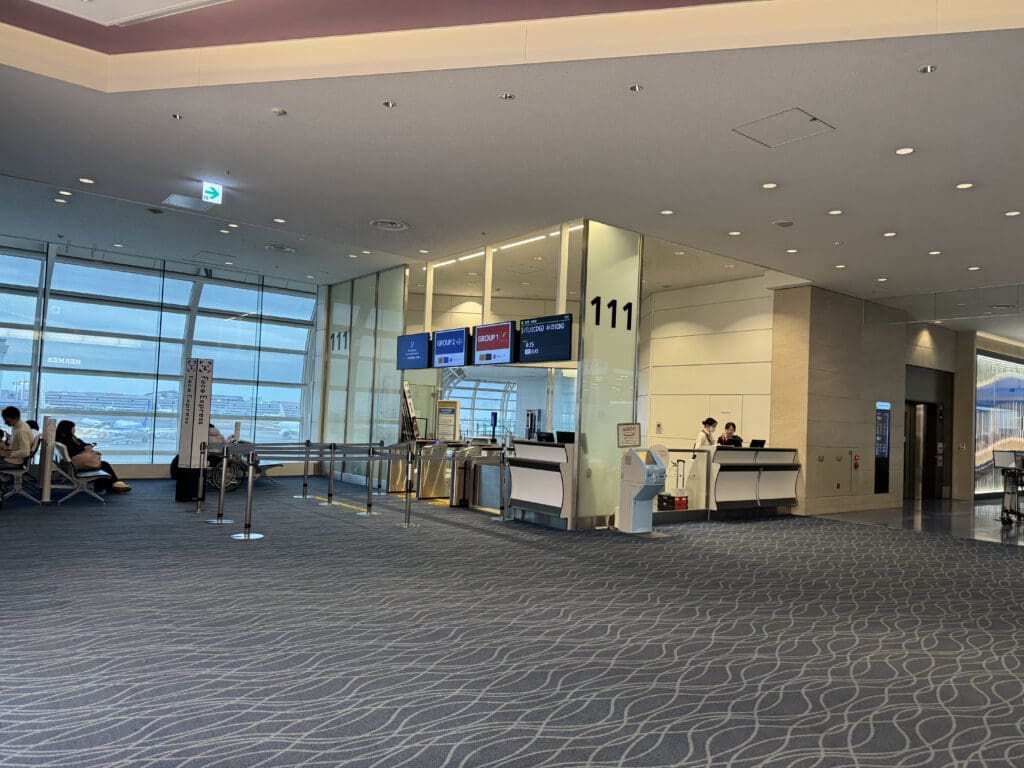
Aircraft arrival times are calculated via the time when the door opens, so a taxi-in delay is a valid reason to be rebooked or claim compensation
How do you plan for a taxi-in delay?
Since you can’t predict when a taxi-in delay will occur, generally I’d recommend having a contingency plan up until the moment the plane door opens:
- As with any other possible delay, have a game plan for what to do if your flight is delayed (and for how long it’s delayed for)
- Taxi-in delays will become more common in the wake of extreme weather events; for example, don’t get too excited if your flight takes off on time, if the arriving airport is going through bad weather or another incident
- Taxi-in delays are also more common at larger airports, since they’re more likely to be slot-constrained: for example, FlightRadar24 has an airport disruption index, so you might want to check that for your arriving airport
- Be mentally prepared for a taxi-in delay during the above circumstances, and don’t consider yourself to have “arrived” until the plane door opens
What do you do when you encounter a taxi-in delay?
When you encounter a taxi-in delay, I’d recommend taking a calm approach, and remember it’s not the fault of anyone that you’ll be interacting with (particularly the flight crew):
- Airlines usually have as much information as you do when you have a taxi-in delay: please don’t pester the flight crew or show them attitude (in most cases, they can’t actually help you rebook your flight)
- If you have a connecting flight, consider your preferred alternative arrangements, so you can present them to the airport counter (if you’re on the same itinerary and they can help rebook you): be your own advocate
- If you’re on different itineraries, consider what time you’ll pull the trigger with booking your alternative arrangement
- I’d recommend using FlightRadar24 to see whether it’s just your flight, or whether the airport itself is at a standstill: this will set expectations for how long immigration/transfer queues will be, which may affect the way you make other plans
- If possible, check your airline app to see whether the airline has made alternative arrangements for you, even after the plane door has opened
In summary, treat a taxi-in delay as you would any other delay, with the added advantage of having an internet connection (as you’ll be on the ground). Take advantage of that internet connection to keep your subsequent travel arrangements under control, only contacting airline ground staff for support if it involves a rebooking. Don’t take your frustration out on the flight crew, as they’re as keen to get off the plane if you are.
Conclusion
A taxi-in delay is one of the most annoying forms of delay – you’ve just had a long flight and can probably see the airport terminal, yet it still messes up with subsequent travel arrangements. This is most likely to happen during adverse weather events or major operational incidents. When this happens, use the fact that you’re on the ground to consider your contingency plans, and don’t take your frustration out on the flight crew.
What’s the longest taxi-in delay you’ve ever faced?